
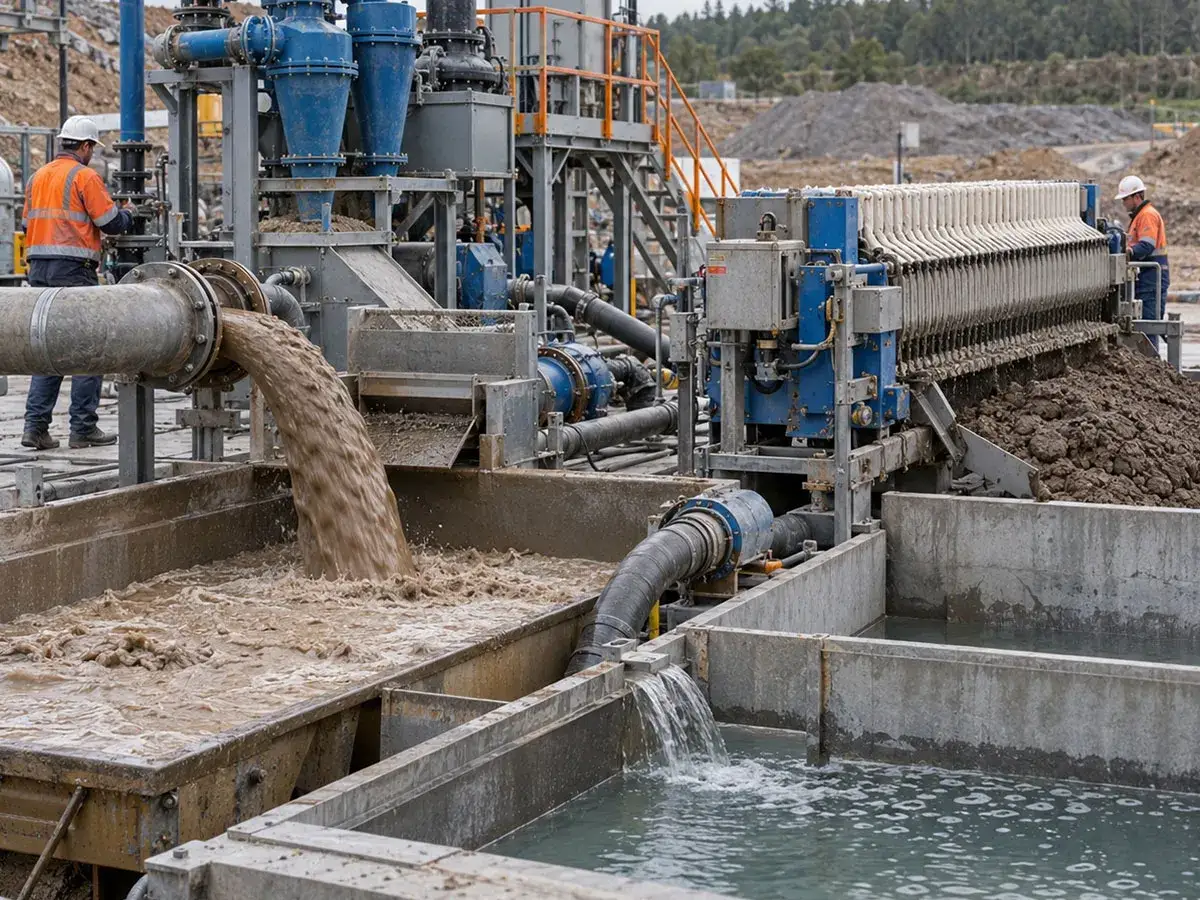
Slurry Treatment Solution
Slurry or sludge from different sources differ greatly in sand content, moisture content, organic matter content, and dewatering performance. As such separation, thickening, conditioning, and dewatering processes are configured to the sludge characteristics and the final disposal requirements. We provide slurry-water separation solutions for construction slurry and sludge thickening and dewatering solutions for municipal and industrial sludge. Construction slurry treatment capacity ranges from 30 to 500 m³/h, while sludge dewatering capacity ranges 5 to 500 t DS/d (dry solids per day). Equipment and processes are configured to the slurry or sludge characteristics, treatment volume, target moisture content, and final disposal method.
| Slurry Type | Typical Sources | Recommended Treatment |
| Construction Slurry | Piling, diaphragm walls, shield tunneling, pipe jacking, horizontal directional drilling | Hydrocyclone desanding and filter press dewatering |
| Sand Washing and Aggregate Slurry | Sand and gravel aggregate washing, stone processing | Thickening, Filter Press, and Clear Water Reuse |
| River Dredging Sediment | River and lake dredging, port dredging | Geotextile Bags or Filter Press and Contamination Assessment |
| Municipal Excess Sludge | Biological treatment and sedimentation systems at wastewater treatment plants | Thickening, Conditioning, Dewatering, and Stabilization |
| Chemical Sludge | Processing stages including coagulation, neutralization precipitation, and dissolved air flotation | Hazardous waste determination and plate-and-frame advanced dewatering |
| Industrial Biological Sludge | Biological treatment systems for industrial wastewater | Enhanced conditioning and advanced dewatering |
The specific treatment process and dewatering equipment are determined from sludge characterization results, treatment volume, and final disposal requirements.
-
- Treatment Capacity: 30 to 500 m³/h
- Process Flow: Slurry Tank → Vibrating Screen → Hydrocyclone desanding → Hydrocyclone desliming → Thickening → Flocculation → Plate-and-Frame Filter Press → Sludge Cake Removal
Construction Slurry-Water Separation SolutionFor construction slurry from piling, diaphragm wall construction, shield tunneling, pipe jacking, and horizontal directional drilling. The slurry treatment system can also treat slurry from sand washing and sand and gravel aggregate production, depending on slurry characteristics.
-
- Treatment Capacity: 5 to 500 tDS/d
- Process Flow: Sludge → Thickening → Chemical Conditioning → Mechanical Dewatering → Stabilization or Subsequent Disposal
Municipal and Industrial Sludge Thickening and Dewatering SolutionsFor excess sludge from wastewater treatment plants, industrial biological sludge, and chemical sludge.
-
- Process Flow: Sludge conditioning → Diaphragm plate-and-frame advanced dewatering → Thermal drying → Utilization or disposal.
Advanced Dewatering and Subsequent Disposal -
- Process Flow: Thickening sludge → Pretreatment or Thermal hydrolysis → Anaerobic digestion → Biogas purification and utilization → Digested sludge dewatering
Anaerobic Digestion and Biogas Utilization